A Day in the Life: What a Hospital Outpatient Coder Actually Does
Terry Stagg
April 22, 2026
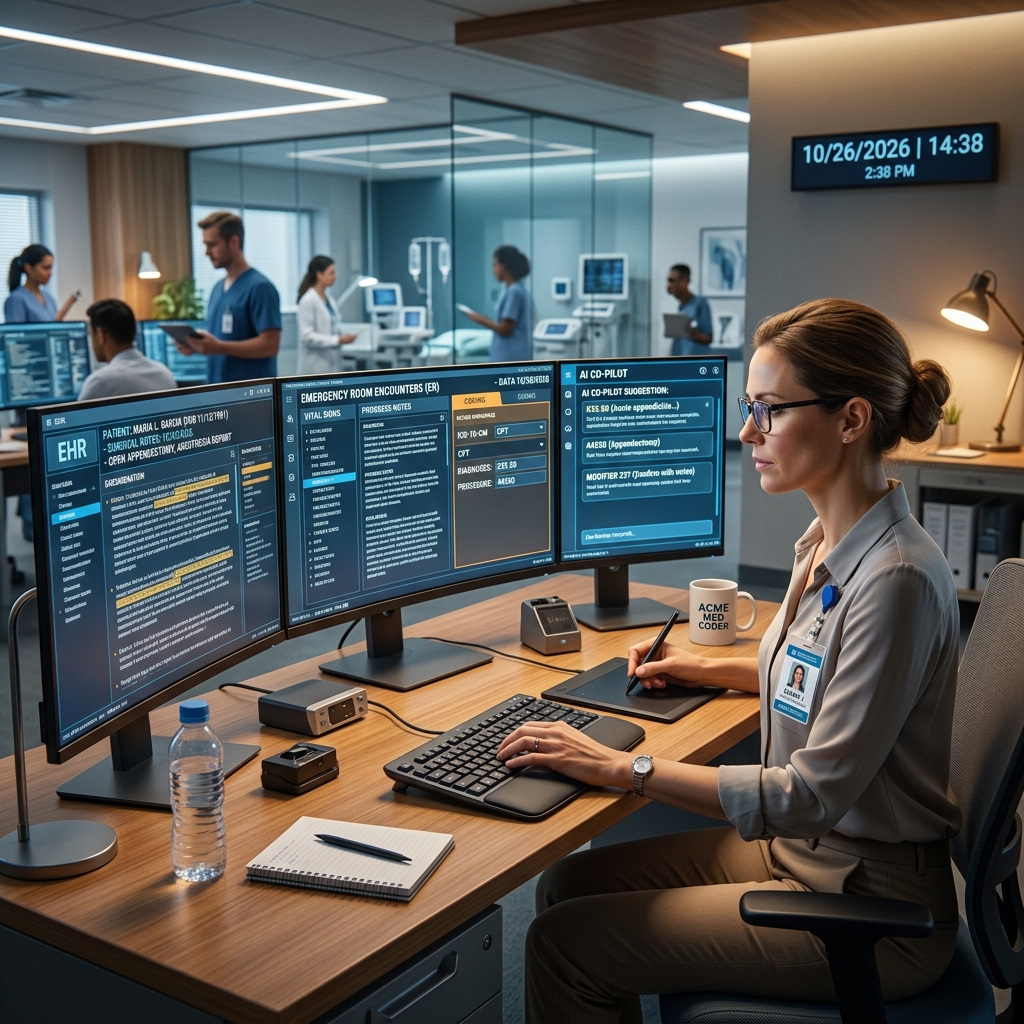
If you like the idea of being a high-speed "information processor" at the center of a medical facility, Hospital Outpatient (OP) Coding might be your calling. Outpatient coding is about volume, variety, and rapid-fire clinical decision-making.
In 2026, outpatient services account for the majority of a hospital's revenue. As an OP coder, you ensure the hospital is reimbursed correctly under the Outpatient Prospective Payment System (OPPS).
Let's walk through a typical 8-hour shift.
1. 8:00 AM – The "Digital Huddle"
Most outpatient coders start by logging into a "Coding Queue" within an EHR like Epic or Cerner.The queue is a list of encounters categorized by discharge date. Your goal is to keep the DNFB (Discharged Not Final Billed) number as low as possible to maintain the hospital's cash flow.
2. 9:00 AM – Same-Day Surgeries
The first few hours are usually dedicated to outpatient surgeries: gallbladder removals, colonoscopies, or carpal tunnel releases.The Workflow: You open the Operative Note, scan for the Approach (robotic vs. open), the Findings, and the Closure. You then link the CPT code to the ICD-10-CM diagnosis that proves Medical Necessity.
3. 11:00 AM – The Chaos of the ER
Next, you pivot to Emergency Department coding. This uses Facility E/M Levels.While the doctor bills for their brain power, the hospital bills for the facility resources used (nursing time, supplies). You look at the "acuity"—was it a sore throat (Level 1) or a Level 5 trauma requiring multiple IVs and a CT scan?
4. 1:00 PM – The "Soft Skill" Hour
After lunch, you tackle charts with "Red Flags." You find an ED note for "Shortness of Breath," but labs show Congestive Heart Failure (CHF). You cannot code CHF without a doctor's statement, so you draft a professional query.5. 2:30 PM – Ancillary Services and "Hard-Coding"
Simple tests—like basic blood draws—are often "Hard-Coded" directly from the Chargemaster. However, you are responsible for "Cleaning the Edits." If a lab test lacks a supporting diagnosis, you must find it in the record to prevent a Medical Necessity Denial.6. 4:00 PM – The Quality Wrap-Up
Before logging off, you perform a Self-Audit. Did you forget modifier -25? Is laterality consistent? Did you check CCI Edits to prevent unbundling? Maintaining a 95% accuracy rate is the professional standard.7. The 2026 Reality: AI as your "Co-Pilot"
You likely have Computer-Assisted Coding (CAC) running. AI highlights keywords and suggests codes, but you are the "human safety net" that ensures the final data is true.Conclusion: A Career of Constant Variety
A day in the life of an OP coder is never boring. You are a detective, a translator, and a financial guardian. If you enjoy seeing the immediate impact of your work, this is a fantastic path.Coming up next: Telehealth Billing in 2026: How Virtual Visits Changed the Rulebook.

Terry Stagg
With 36 years in healthcare and 27 years as a Director of Information Systems, Terry Stagg bridges the gap between clinical documentation and the revenue cycle. He is a technology specialist and hospital data expert.