Directional Terms
Precision is the soul of coding. You cannot assign a code to a "shoulder pain" until you know if it's Anterior, Posterior, or Lateral.
Directional Compass
Select a directional pair to explore anatomical relationships.
Oppositional Anatomy
Superior (Cephalic)
Toward the head or upper part of a structure.
Inferior (Caudal)
Away from the head or toward the lower part of a structure.
How it's used in Medical Records
"The procedure was performed on the Inferior aspect of the limb..."
The Coding Catch
In spinal coding, identifying Superior vs Inferior vertebrae levels (e.g., C3 vs C4) is the difference between coding a 'Primary level' or an 'Additional level' in CPT.
The Anatomical Position
All directional terms used in medicine assume the body is in the Anatomical Position: standing upright, feet flat, facing forward, with arms at the side and palms facing forward.
- Why? Because a patient's "Left" is your "Right" when facing them.
- Consistency: Directional terms prevent surgical errors by ensuring the coder, the surgeon, and the nurse are looking at the exact same site.
Coding Pro-Tip: Laterality
Most ICD-10 codes for limbs require a 6th or 7th character to specify Right (1), Left (2), or Bilateral (3). Without directional terminology like 'Lateral' or 'Medial' in the note, you may be forced to use 'Unspecified' (0), which is a major cause of payer rejections in 2026.
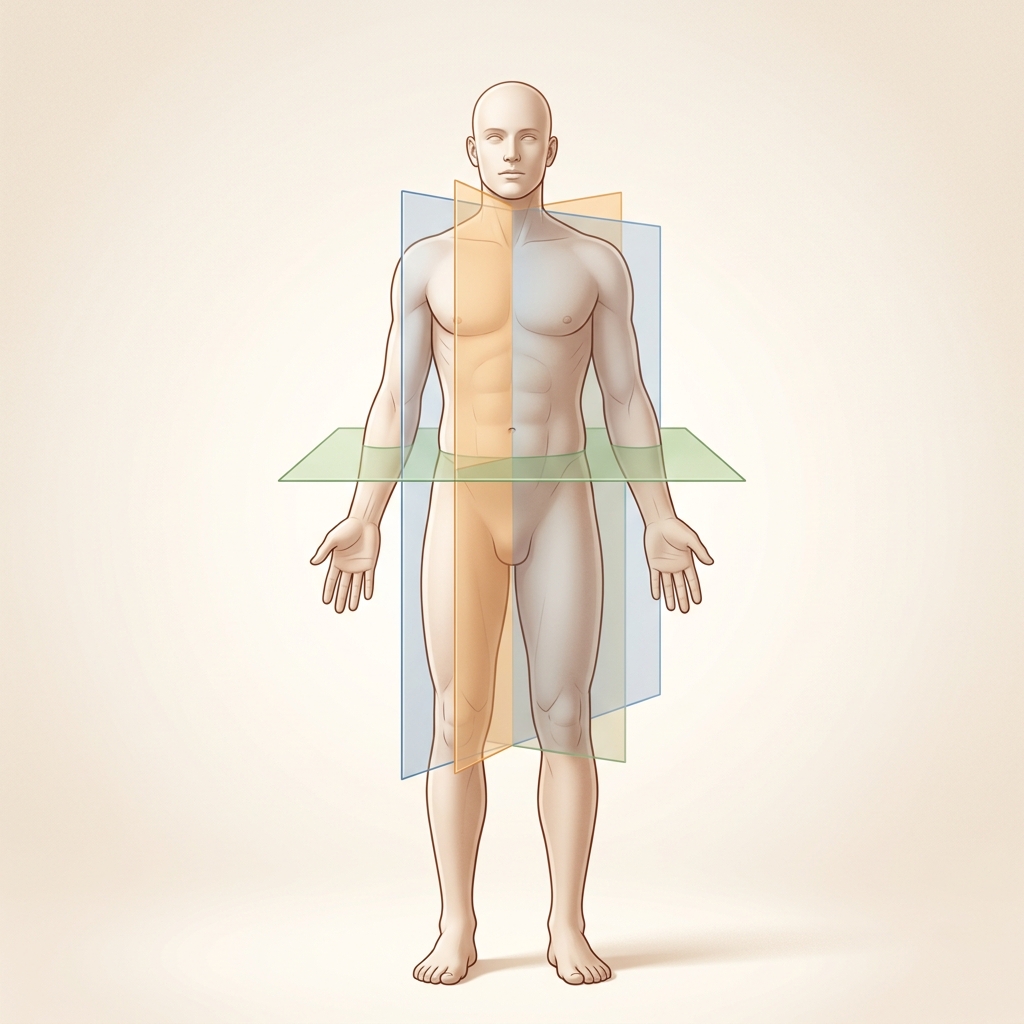
The 3 Planes of Reference
Sagittal Plane
Divides the body into Right and Left sections.
Frontal (Coronal) Plane
Divides the body into Front (Anterior) and Back (Posterior) sections.
Transverse Plane
Divides the body into Upper (Superior) and Lower (Inferior) sections.
Expert Deep Dive
Moving from the classroom to the workstation? Use this expert checklist to highlight the technical skills every entry-level coder needs to stand out.
The Resume Checklist: 5 Essential Skills
Terry Stagg
With 36 years in healthcare and 27 years as a Director of Information Systems, Terry Stagg bridges the gap between clinical documentation and the revenue cycle. He is a technology specialist and hospital data expert.
Next Step
You've mastered the anatomical foundation. Ready to see how coding drives the healthcare economy?
Module 5: Revenue Cycle