Breaking Down the Big Words: A Master Guide to Medical Roots, Prefixes, and Suffixes
Terry Stagg
April 10, 2026
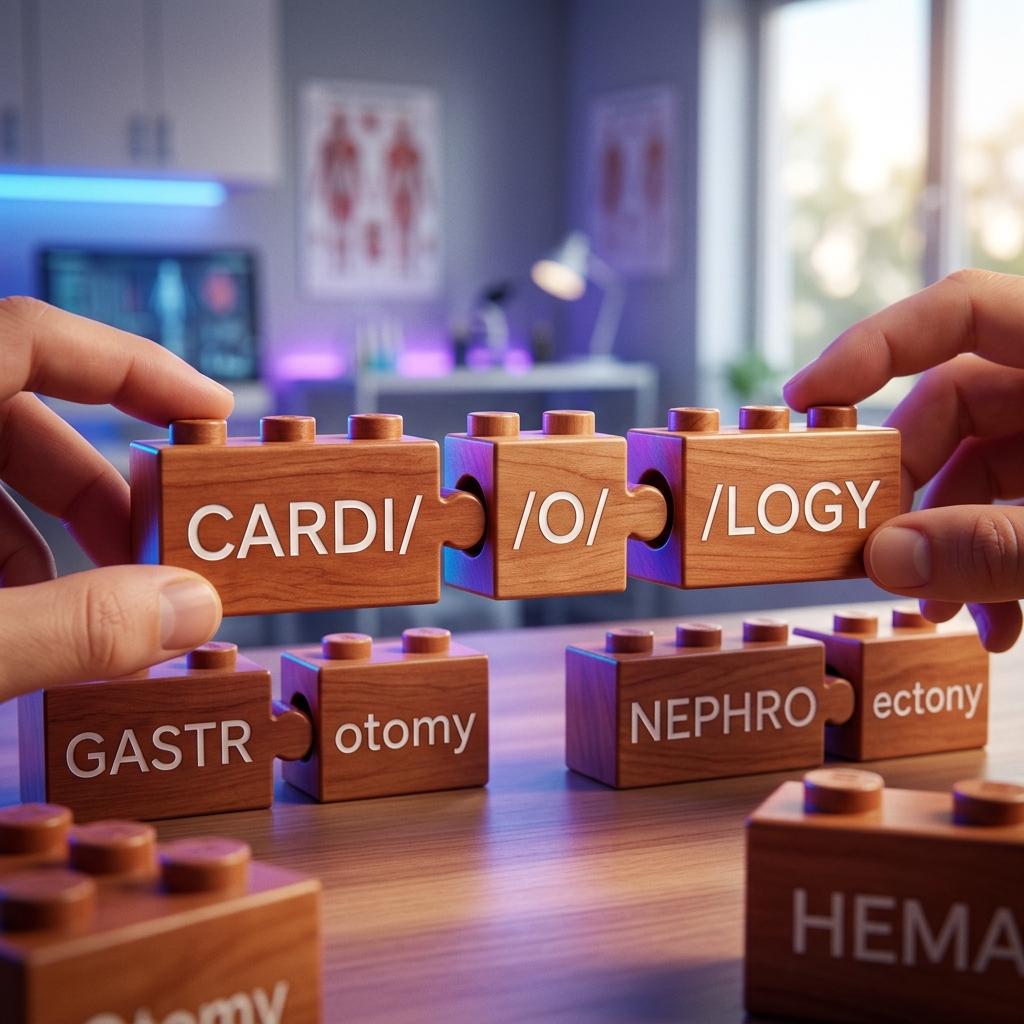
If you are just beginning your journey into medical terminology and coding, looking at a patient’s chart can feel like reading a foreign language. Words like choledocholithiasis or encephalomyeloradiculitis look like alphabet soup designed specifically to intimidate the uninitiated.
However, there is a "cheat code" to mastering this language. Medical terminology is not a collection of thousands of individual words to be memorized by rote; it is a modular system. It is essentially a LEGO set of linguistic building blocks. Once you understand the prefixes, roots, and suffixes, you can deconstruct almost any term in the medical dictionary—even if you’ve never seen it before.
In this guide, we’re going to break down the "Big Words" into their fundamental parts, providing you with a framework that will serve as the foundation for your entire coding career.
1. The Anatomy of a Medical Word
Every complex medical term is composed of at least one of these four components:The Golden Rule of Decoding: To understand a medical term, you almost always read from the end (suffix) back to the beginning, and then across.
2. The Word Roots: Your Anatomical Map
The root is the "subject" of your sentence. Most roots are derived from Greek or Latin. Interestingly, Greek roots often describe diseases or conditions, while Latin roots often describe anatomical structures.Common Roots You’ll See Daily:
Coding Connection: In the ICD-10-CM manual, the chapters are largely organized by body systems. Knowing your roots allows you to flip to the correct chapter (like Chapter 9 for Circulatory/Cardi or Chapter 13 for Musculoskeletal/Osteo) much faster during a timed exam.
3. Prefixes: Setting the Scene
Prefixes tell you where, when, or how much. They provide the context for the root.Position and Direction
Numbers and Amounts
4. Suffixes: The "What Happened?"
The suffix is the most important part for a coder because it often describes the encounter or the diagnosis.Surgical Suffixes (Vital for CPT Coding)
Diagnostic/Symptomatic Suffixes
5. Putting it All Together: A Case Study
Let’s look at a daunting term: Otorhinolaryngology.Translation: The study of the ear, nose, and throat.
What about Cholecystectomy?
Translation: Surgical removal of the gallbladder.
6. Why This Matters for Your Career
You might wonder, "Can't I just Google these terms?" In a classroom setting, perhaps. But in the professional world of medical coding, "decoding" on the fly is a matter of efficiency and accuracy.Speed: When you’re taking your CPC (Certified Professional Coder) or CCS exam, you are under a strict time limit. If you spend three minutes looking up every term in the index, you won’t finish. Knowing that -malacia means "softening" allows you to instantly recognize Osteomalacia* as a bone condition. Accuracy: Doctors are busy. Sometimes, their dictation might be slightly unclear. If you see a diagnosis that looks like "Hepatitis" but the doctor is describing a kidney procedure, your knowledge of roots (Hepat vs. Nephr*) will trigger a "red flag," allowing you to query the physician for clarification before a costly billing error occurs.
7. How to Practice (Without Losing Your Mind)
If you are an adult learner or transitioning careers, your time is valuable. Don’t just read a list of words. Use these active learning strategies:Conclusion
Medical terminology isn't about memorizing 20,000 words. It’s about memorizing about 200 components and understanding the rules of how they stick together. Once you master the "Big Words" by breaking them down into small pieces, the entire world of medical coding opens up to you.Stay tuned for our next post, where we will look at the best digital tools and apps to help you keep these terms fresh in your mind as you prepare for your certification exams!

Terry Stagg
With 36 years in healthcare and 27 years as a Director of Information Systems, Terry Stagg bridges the gap between clinical documentation and the revenue cycle. He is a technology specialist and hospital data expert.